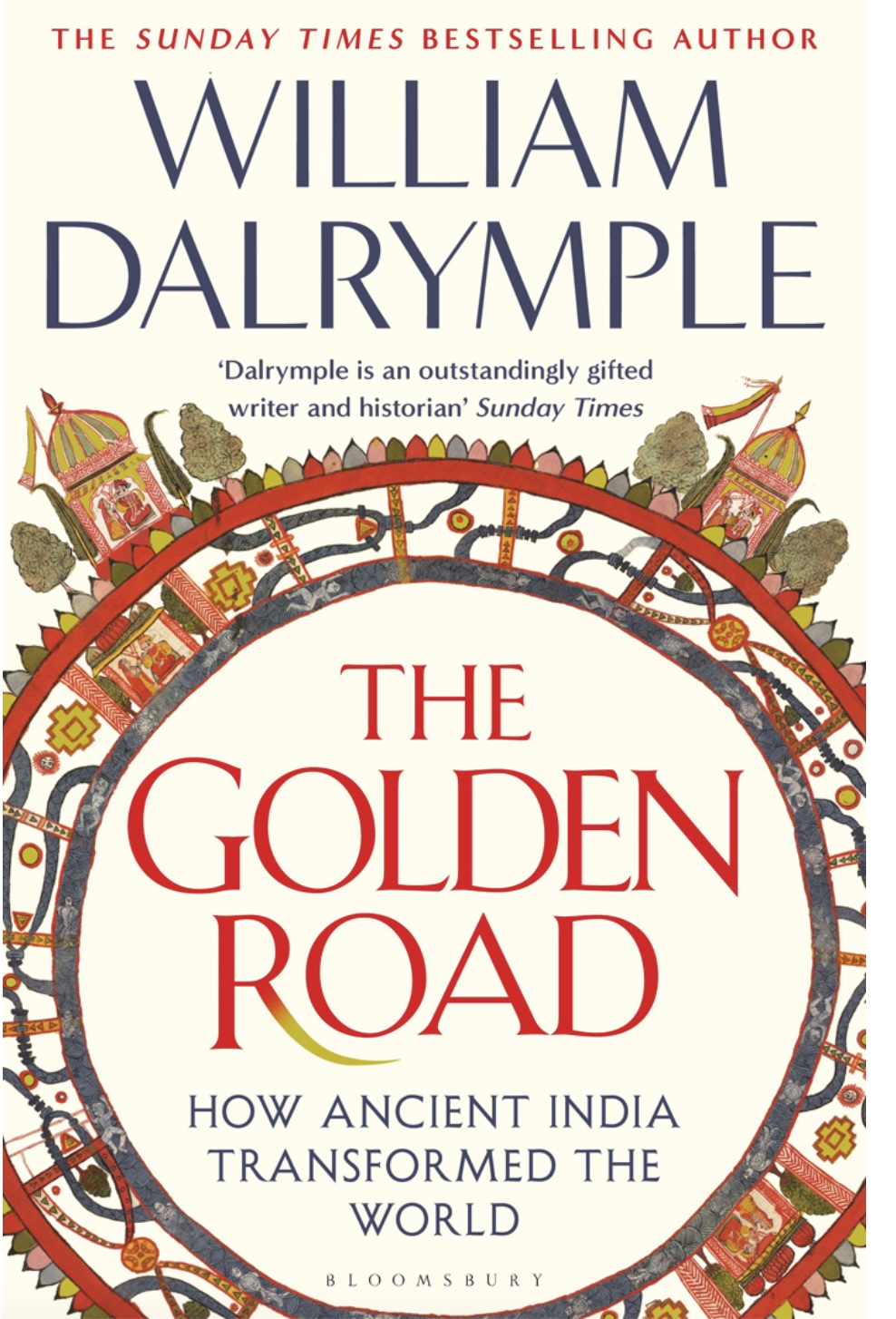
The historian A.L. Basham wrote a book called The Wonder That Was India. William Dalrymple ringingly extols the wonders of that land in The Golden Road, offering a paean to ancient India as a fountainhead of human civilisation.
Dalrymple paints a fascinating portrait of a civilisation that, for over a millennium, was a beacon of ideas, knowledge, and spirituality. From approximately 250 BCE to 1200 CE, India was not just a regional power but the very heart of a dynamic and expansive intellectual empire that reached far beyond its borders. This influence, which spanned religion, art, literature, science, and philosophy, was disseminated not through the force of conquest, but by the alluring sophistication of Indian culture and its deep resonance with the peoples it encountered.
India’s cultural reach led to the spread of Sanskrit, a language that transcended its early role as a sacred tongue to become a powerful literary and political medium by the first century CE. As the renowned scholar Sheldon Pollock noted, Sanskrit was more than just a language; it was a “lingua franca” that united vast swaths of Asia, from the mountainous terrains of Afghanistan to the island nation of Singapore. The Sanskrit-speaking elite of Southeast Asia, deeply immersed in Indian mythologies and traditions, often named their cities after places from the great Indian epics. Ayutthaya, the ancient capital of Thailand, for example, was named after Ayodhya, the kingdom of Lord Rama in the Ramayana, a story that would shape the spiritual and cultural landscapes of Southeast Asia for centuries.
But India’s influence did not stop at the written word. The subcontinent’s intellectual output in fields as diverse as astronomy, mathematics, medicine, and architecture profoundly nifluenced civilisations from the Indian Ocean to the Pacific. Indian merchants, scholars, and religious missionaries traversed the monsoon-driven sea routes, taking with them not only goods but also profound ideas that would shape the religious and philosophical foundations of Southeast and East Asia. Hinduism, Buddhism, and other forms of Indian spiritual thought took root and flourished across this vast expanse, each adapting to local customs and traditions but always bearing the unmistakable mark of their Indian origin.
The Indian influence is still evident today. The towering temples of Angkor Wat in Cambodia drew inspiration from Indian architectural styles.
Dalrymple also delves into the critical role India played in shaping the intellectual history of the Islamic world and, by extension, medieval Europe. Indian advancements in mathematics, particularly the concept of zero, the decimal system, and algebra, were transmitted through the Islamic world to Europe. The famed mathematician Fibonacci, for example, popularised the Indian numeral system in Europe after picking it up from the Arabs.
The Golden Road acknowledges the paradox at the heart of India’s global influence: the profound, transformative effect of Indian culture on its neighbours, contrasted with how little is known or remembered about this influence today. Colonial narratives often undermined or misrepresented India’s contributions, obscuring the rich and far-reaching legacy of India’s intellectual and cultural empire.
The Golden Road vs the Silk Road
Dalrymple critiques the Sinocentric narratives that dominate much of Asia’s historical discourse today. According to him, far more trade and culture flowed through the Golden Road, or the Indian maritime routes, than through the Silk Road, which led to China.
“Despite its modern popularity the idea of a Silk Road was completely unknown in ancient or medieval times: not a single ancient record, either Chinese or western, refers to its existence,” he writes.
“Instead, it was invented as late as 1877 by a Prussian geographer, Baron von Richthofen, who, while engaged in a geological survey of China, was charged with dreaming up a route for a railway linking Berlin with Beijing with a view to establishing German colonies and infrastructure projects in the region. This route he named the Silk Roads’ — the first use of the term.
“It was not until 1938 that the term Silk Road appeared in English, as the title of a popular book by a Swedish explorer, Sven Hedin.
“Since then, the term has captured the global imagination and the ‘reopening’ of the Silk Road has been announced by President Xi Jinping of China as part of his Belt and Road Initiative.”
But Dalrymple says: “The reality is very different. Although overland trade routes through Iran were clearly of central importance when Mongol rule stretched from the Mediterranean to the South China Sea during the thirteenth century, this was not the case during the classical and early medieval era. Indeed the Roman Empire and China actually had only the haziest notions of each other’s existence – vaguely aware of each other, but almost never in direct contact.”
Dalrymple writes: “The highly nationalistic and Sinocentric reframing and rebranding of history portrayed the trading world of the Silk Roads in idealised terms as a network of peaceful global exchange centred on China, which was depicted as the principal economic engine powering world trade…
“But history tells a quite different story. In the crucial period between the end of antiquity and the onset of the high Middle Ages, you can make at least as good a case for India being the cultural and intellectual centre of Asia, influencing and changing the course of religious, artistic and cultural life in all the regions around it, not least in China itself. This after all was why [the Chinese scholar] Xuanzang, and many others like him, risked their lives to make the dangerous journey to what was then the Harvard or MIT of ancient Asia: the great Buddhist university of Nalanda.”
Dalrymple adds: “Unlike China, India was rarely even partially united in ancient times — when Xuanzang reached what he regarded as the geographical borders of India at Jallalabad in the seventh century CE, he remarked that he was entering a holy land, ‘the Five Indias’ made up of ‘more than seventy’ distinct kingdoms. But, for all its political fragmentation, the idea of India as a single cultural, sacral and geographical unit was still clearly understood from the very earliest times.
“Xuanzang was not alone in having a clear understanding of the geographical boundaries of the fractured land he called India: his fifth-century CE predecessor, the Chinese monk Faxian, had similar ideas of a country ‘triangular in shape, broad in the north and narrow in the south’ Before that, the historian Strabo tells how Alexander the Great talked to sadhus who conceived of their homeland as stretching ‘from the mouth of the Indus in the west to the mouth of the Ganges in the east, from the mouth of the Ganges to the tip of southern India, and from there, again, to the mouth of the Indus’, The Mahabharata, which was in the process of composition at around the same time, gives an even more concise definition: ‘the land north of the seas and south of the Himalayas is called Bharata, where the descendants of King Bharata lived’.
Dalrymple affirms: “This India, or Bharat, however defined, was one of the two great intellectual and philosophical superpowers of ancient Asia, fully the equal to China in the broader ancient world. It set the template for the way much of the world would think and express itself, and would significantly alter the trajectory of the history of a great swathe of mankind. For more than a thousand years it was a garden that issued the seeds that, once planted elsewhere, flowered in new, rich and unexpected ways.”
 Readiscovery