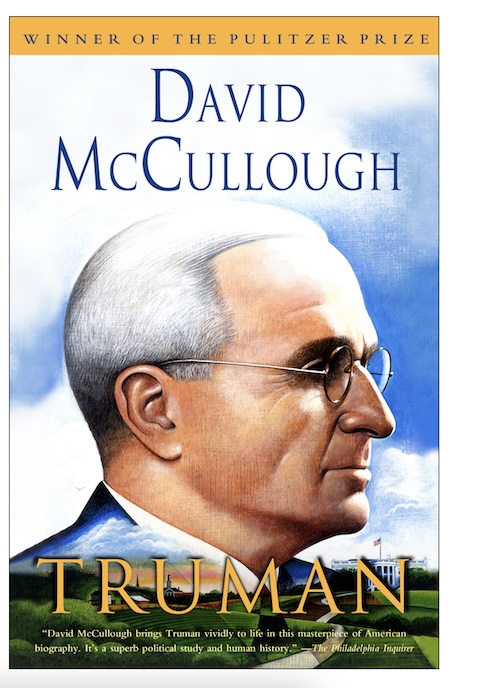
He approved the plan to drop atomic bombs on Japan to end World War II. He had American troops defend South Korea from North Korean aggressors backed by Russia and China. His actions shaped the postwar world, binding Japan and South Korea to America. Yet Harry Truman, the 33rd US president, remained an ordinary man to his fellow Americans rather than the world leader he was during his almost eight years at the White House.
Completely overshadowed by his predecessor, Franklin Delano Roosevelt, he was called the “little man from Missouri” and “the failed haberdasher from Independence, Missouri”. What the gibes ignored was that the senator from Missouri became the vice president during Roosevelt’s fourth term because their fellow Democratic leaders felt that Roosevelt needed Truman to be assured of victory in the 1944 election.
Vice President
Truman was vice president for 82 days. Roosevelt did not prepare him for the tasks he would face if he became president. Yet, from day one, Truman knew the job would be his for Roosevelt’s health was declining even before the election. His biographer, David McCullough, describes what he went through when Roosevelt died at Warm Springs, Georgia, on April 12, 1945.
Truman was in Washington, where he was called to the White House to receive the news. Roosevelt’s widow, Eleanor, was waiting for him in the private quarters. “Harry, the President is dead,” she said. “Is there anything I can do for you?” he asked. “Is there anything we can do for you?” she said. “For you are the one in trouble now.”
Truman, however, was a quick study and proved equal to his responsibilities, as many of those who knew him expected.
I have been browsing through the book Truman by David McCullough and, at the same time, dipping into Robert Caro’s magisterial multivolume biography of Lyndon Baines Johnson. The volume I have found ends with Johnson’s inauguration as president after the assassination of John F. Kennedy.
I am struck by the differences between Caro and McCullough. Caro describes every little detail, making the biography unfold like a movie. McCullough’s narrative reads more like a newspaper of record. He recounts the incidents without elaborating on every detail. He captures the drama of how Truman became vice president without going into overwhelming detail.
President Roosevelt approved of him, but the president was too ill — and dying — to back Truman wholeheartedly, leaving the decision instead to the Democratic Party leaders.
The party leaders wanted Truman, but the erstwhile vice president, Henry Wallace, was not ready to step down. There was a nomination battle at the Democratic convention in Chicago. Truman won the fight, securing more votes than Wallace, and delivered the shortest acceptance speech in under a minute. So says McCullough, who then passes on to other matters instead of dwelling on the politicking, as Caro might have done.
White House and after
Plain-spoken and unassuming, Truman remained underestimated as president. He was expected to lose when he ran for election in 1948. But he won after his famous whistlestop railway tour, reaching out to voters. They could relate to him when he spoke to them, appearing with his wife, Bess, and daughter, Margaret. He spoke the language of the ordinary people and understood their concerns.
Truman was not rich like other presidents. He had no income or support of any kind from the federal government when he stepped down as president other than his army pension of $112.56 a month. Indeed, one of the reasons he returned to the old house in Independence was that, financially, he had little other choice. It was a grand homecoming, however, as people turned out in their thousands to welcome him when he arrived by train, and he and his wife, Bess, were overjoyed.
His financial position improved when he sold the exclusive worldwide rights to his memoirs to Life magazine for $600,000 – a fantastic sum in 1953 – to be paid in instalments over five years. He bought a new car, a four-door black Chrysler, for Bess, and another new car, a Dodge coupe, for himself. They vacationed for a month in Hawaii with their daughter, Margaret. Then he and Bess set off in the Chryslet on a long drive to Washington. Reporters, photographers and admirers greeted them on their journey. They enjoyed the attention.
Greatness
Truman’s biographer, David McCullough, recalls what a great man he was in the final pages of his biography.
McCullough writes:
“He said he lived by the Bible and history. So armed, he proved that the ordinary American is capable of grandeur.
“And that a President can be a human being…
“He was remembered in print and over the airwaves, in the halls of Congress and in large parts of the world, as a figure of courage and principle…
“The obituary in The New York Times ran seven pages. (When the writer, Alden Whitman of The Times, had been preparing it in advance years before and went to Independence to interview Truman himself, feeling extremely uneasy about the whole assignment, Truman greeted him with a smile, saying, ‘I know why you’re here and I want to help you all I can.’)
“In a day of memorial tributes in the Senate chamber that he so loved, he was eulogised as the president who had faced the momentous decision of whether to use the atomic bomb, praised for the creation of the United Nations, for the Truman Doctrine, the Marshall Plan, the Berlin Airlift, the recognition of Israel, NATO; for committing American forces in Korea and for upholding the principle of civilian control over the military…
“He was remembered as the first president to recommend Medicare, remembered for the courage of his stand on civil rights at the risk of his political fortunes…
McCullough continues:
“Ambitious by nature, he was never torn by ambition, never tried to appear as something he was not. He stood for common sense, common decency. He spoke the common tongue. As much as any president since Lincoln, he brought to the highest office the language and values of the common American people. He held to the old guidelines: work hard, do your best, speak the truth, assume no airs, trust in God, have no fear. Yet he was not and had never been a simple, ordinary man. The homely attributes, the Missouri wit, the warmth of his friendship, the genuineness of Harry Truman, however appealing, were outweighed by the larger qualities that made him a figure of world stature, both a great and good man, and a great American president.”
Praising Truman, McCullough writes:
“With his ability to ‘take it’, his inner iron, his bedrock faith in the democratic process, his trust in the American people, and his belief that history was the final, all-important judge of performance, he was truly exceptional. He never had a doubt about who he was, and that too was part of his strength, as well as the enjoyment of life he conveyed.
“He was the kind of president the founding fathers had in mind for the country. He came directly from the people. He was America.”
McCullough recalls the words of author and journalist Eric Sevareid, who said of Truman: “I am not sure he was right about the atomic bomb, or even Korea. But remembering him reminds people what a man in that office ought to be like. It’s character, just character. He stands like a rock in memory now.”
McCullough concludes his life of Truman by noting:
“He had lived eighty-eight years and not quite eight months. Bess Truman lived on at 219 North Delaware for another ten years. She died there on October 18, 1982, and was buried beside him in the courtyard of the Truman Library.”
And thus ends the biography, the great man recalled in all his goodness, at rest with his beloved wife.
 Readiscovery