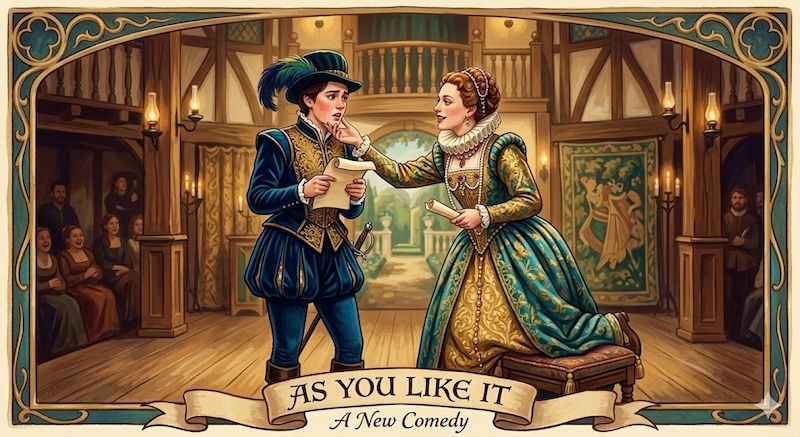
The Oxford Dictionary of English gives only a partial definition of comedy. A comedy, it says, is a film, play or broadcast programme intended to make an audience laugh. That is true as far as it goes, but it misses something essential. What truly defines a comedy is not simply that it entertains, but how it ends — in a happy resolution, often a marriage. That is the hallmark of comedy as a genre. It must end happily.
Not that we always mean a film, play or broadcast programme when we talk of comedy. We can also mean the humorous side of something, says Oxford, citing this sentence as an example: “Advertising people see the comedy in their work.” Comedy, then, refers both to a genre of films, plays and shows and to the funny side of life itself. Perhaps that duality explains why the word sired not one but two adjectives: “comic” and “comedic”.
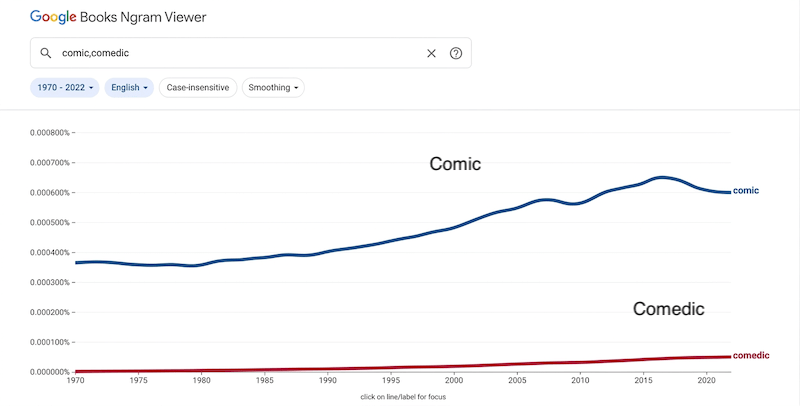
Google Ngram Viewer shows a slight increase in the use of “comedic” since around 2000.
I was mistaken when I thought “comedic” was a newfangled word. It goes back to 1639, according to the Oxford English Dictionary. The older word, “comic”, dates back even further, to 1549. Perhaps “comedic” came about because “comic” was felt to be too general — it could mean funny, or characteristic of comedy as a literary form. “Comedic” was coined to apply specifically to comedy the genre. Yet it never quite caught on. “Comic” remained dominant because it had so many meanings — funny, a comedian, a comic book or comic strip. “Comedic” was the more precise word, but precision is not always what language wants.
That said, “comedic” has gained ground in the new millennium. Consider this from The Guardian, writing about Cher in April 2015: she is described as “a knowing comedic genius” who is “trying to make herself laugh as much as anyone else.” I would have written “comic genius” myself — and so, it seems, would The New Yorker, which described Beatrix Potter in 2009 as “a comic genius.”
So much for the words. What of the thing itself?
Comedy as a literary form is ancient, and its defining characteristic — the happy ending — has remained remarkably stable across the centuries. Shakespeare’s comedies are called comedies not because they include funny moments, but because they end happily: heroes married to heroines, rightful leaders restored to their authority, the social order renewed and celebrated. It is worth noting that Shakespeare also included funny moments in his tragedies — the Porter scene in Macbeth is a famous example. They are there to provide comic relief, a deliberate lightening of the mood before the darkness closes in again. Funny moments alone do not make a comedy. What defines a comedy is its progress from problems to happiness with a satisfactory resolution.
Shakespeare
Shakespeare’s comedies include happy pastorals like As You Like It as well as the so-called Problem Plays, and the label is instructive. These are works that end happily enough on the surface but carry an undertow of unease. The Merchant of Venice, though not originally classified as a Problem Play, is perhaps the most troubling of all. It ends with marriages and music in line with Shakespearean comedy, yet its treatment of Shylock casts a long shadow. The play exposes antisemitic prejudice, and many who love Shakespeare find The Merchant of Venice painful for precisely that reason. It is a reminder that a writer cannot fully suppress what is true about the world. Writers reflect the society they live in.
Wodehouse and Jane Austen
For wholly carefree laughter, unclouded by any shadow of cruelty or injustice, one must turn to P.G. Wodehouse. His world is a glorious comic confection: prize pigs nobbled before an agricultural show, young men accidentally engaged to wholly unsuitable women, rambling country houses inhabited by eccentric aunts with iron wills and terrifying ideas. The scrapes his characters tumble into are so elaborately improbable, so magnificently divorced from the pressures of ordinary life, that the reader is reduced to helpless, uncontrollable laughter. Wodehouse is rightly called the master of farce. His England is an idealised, sunlit place that never quite existed, and that, perhaps, is the point. Farce offers an escape from reality, a holiday from consequence. Nobody in Wodehouse ever truly suffers.
Jane Austen is a very different proposition. Where Wodehouse invites us to escape from society, Austen plants us firmly inside it. Her comedy is rooted in reality — in the social pressures, the economic anxieties, the subtle cruelties and surprising kindnesses of early nineteenth-century English life. Pride and Prejudice is her masterpiece. It is a love story, yes — the romance between the sharp-witted Elizabeth Bennet and the proud, initially insufferable Mr Darcy — but it is also a precise and unsentimental portrait of a world in which a woman’s future depends almost entirely on whom she marries. The Bennet family estate will pass to a distant male relative because Mr Bennet has no sons. That makes his daughters’ futures uncertain and dependent on good marriages. Austen makes you laugh, but she never lets you forget what is at stake.
Between Wodehouse’s escapism and Austen’s social realism lies the vast and varied landscape of comedy as we know it today. The genre has evolved into various forms: romantic comedies, sitcoms, stand-up, comic books, comic strips, satirical news shows. They may take the shape of love stories or soap operas, cartoons or one-person shows. Yet for all this variety, something unites them. They are all, in their different ways, comments on life. Even Wodehouse, for all his improbable plots, is writing about recognisable human desires — the wish to muddle through, to have things turn out all right in the end.
That, at its deepest, may be what comedy is for. We live in a world that is frequently painful, often unjust, and reliably unpredictable. Comedy does not deny this — the best comedy never does. What it offers instead is a way of looking at difficulty that does not crush us. It finds something to laugh about. And laughter, as they say, is the best medicine.
The happy ending that defines comedy as a genre is what it makes so satisfying. When the lovers are united, when the problems are overcome, when the rightful order is restored, we are not being told that life is always like this. We are being reminded that it can be. In that small, stubborn hope, comedy finds its deepest purpose.
 Readiscovery
You must be logged in to post a comment.