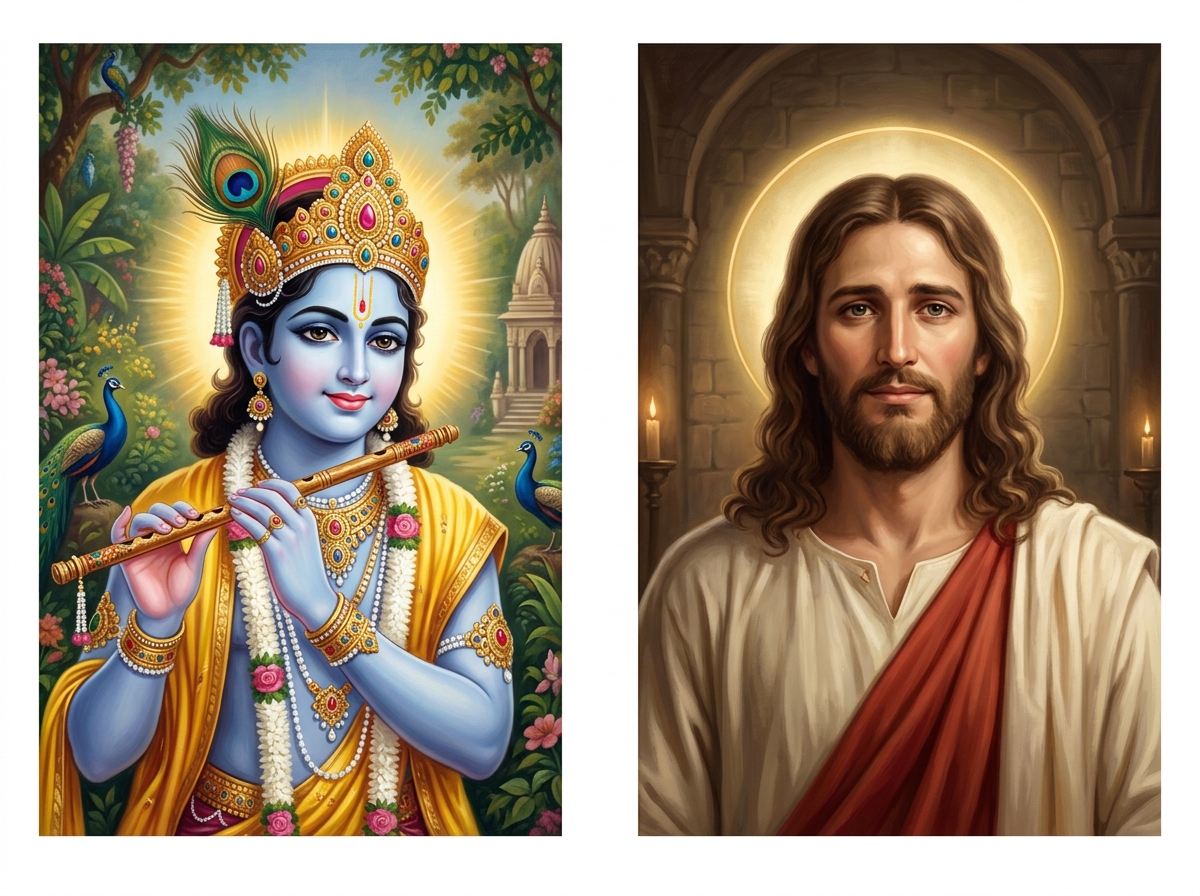
Saved at birth, slain in the end, the preacher and the prince had much in common — and much that set them apart
The ancient Greeks and Romans, whose achievements are among the glories of Western civilization, had more in common in their religious beliefs with Hindus than with the Christian majority in Europe and America today. Like Hindus, they worshipped many gods and goddesses. True, some Greek and Roman philosophers questioned the existence of many gods or doubted divine intervention in human affairs. There were Hindu philosophers, too, who expressed the same scepticism.
Hindus worship many gods, yet Hinduism also teaches that behind them is one supreme divine reality. There is no contradiction in this for a Hindu. The many gods may be seen as different manifestations of the one divine. Some Greek and Roman thinkers also believed in a supreme divine principle or intelligence. But the religion of ordinary Greeks and Romans remained essentially polytheistic.
Later, when Europeans colonized much of the world, the Christian missionaries who went with them believed they were doing God’s work, spreading their faith and bringing others out of darkness. The 19th-century British missionary Reginald Heber, who became the Anglican Bishop of Calcutta, famously wrote in his hymn From Greenland’s Icy Mountains:
“The heathen in his blindness
Bows down to wood and stone.”
The well-meaning missionary apparently forgot that Socrates, Plato and Aristotle were “heathens” too. They were born centuries before Christ and could hardly have been Christians.
I do not say this to disparage Christianity. Far from it. One can love Christian traditions and feel a particular affection for Mother Mary while recognizing that religious zealots of every faith have sometimes looked down on the beliefs of others. What they often fail to see is how much religions have in common beneath their differences in doctrine, ritual and theology.
This is particularly clear when we compare the stories of Jesus of Nazareth and Krishna, the eighth avatar of Vishnu.
Krishna’s birth, celebrated by Hindus on Janmashtami, has some remarkable similarities with the story of the birth and infancy of Jesus. Both begin with a king who is frightened by a prophecy concerning a newborn child.
King Kansa of Mathura was warned that the eighth child of his sister Devaki would cause his death. To save himself, Kansa imprisoned Devaki and her husband, Vasudeva, and killed their first six newborn children. But when Krishna, the eighth child, was born in prison, divine intervention saved him. The guards fell asleep and the prison doors opened. Vasudeva placed the infant Krishna in a basket on his head and carried him across the flooded Yamuna in the darkness of night. The many-headed serpent Shesha protected the child from the torrential rain. Vasudeva eventually reached Gokul, where he left Krishna in the care of his cousin, Nanda, and Nanda’s wife, Yashoda.
Saved at birth
Herod the Great was ruthless when he learnt from the Magi that a child had been born who would become king of the Jews. Fearing for his throne, he ordered the killing of male children aged two and under in and around Bethlehem — the Massacre of the Innocents. But Joseph was warned in a dream by an angel and fled with Mary and the infant Jesus to Egypt. They remained there until Herod died.
Both children, then, escaped a murderous king because their earthly fathers took them to safety. But their lives thereafter could hardly have been more different.
Different lives
Jesus lived simply. Brought up as a carpenter’s son in Nazareth, he had no kingdom, no army and no worldly title. He wandered from place to place preaching, healing the sick and gathering around him fishermen, tax collectors and others who became his disciples. He preached love, forgiveness, spiritual renewal and the coming Kingdom of God. He told his followers to love their enemies and turn the other cheek. He remained unmarried and devoted his life to his ministry.
Krishna’s life was very different. His childhood and youth were spent among cowherds in Vrindavan, where he is remembered for his playful exploits and his love for Radha. Their love later came to symbolize something much deeper in Hindu devotional tradition— the longing of the human soul for the Divine.
Krishna eventually entered the world of royalty and politics. He married Rukmini, regarded as an incarnation of the goddess Lakshmi, after she secretly appealed to him to rescue her from a marriage she did not want. She became his principal queen in Dwarka.
Krishna also played a central part in the great Kurukshetra War between the Pandavas and the Kauravas. He did not fight himself but became the charioteer and counsellor of the Pandava prince Arjuna.
As the two armies faced each other, Arjuna lost his nerve. He saw among the enemy his relatives, teachers and friends and could not bring himself to kill them. Krishna’s answer to Arjuna became the Bhagavad Gita.
Different teachings
Jesus taught his followers to love their enemies, turn the other cheek and refrain from retaliation. His teaching places extraordinary emphasis on forgiveness and non-retaliation.
Krishna gave Arjuna different advice. He did not glorify violence or tell Arjuna to fight out of anger, hatred or a desire for revenge. His argument was based on dharma, or righteous duty. Arjuna was a warrior, and Krishna told him that he could not abandon his duty merely because he loved or respected some of those on the other side.
Krishna also taught him one of the central ideas of the Gita: the soul is eternal. It cannot kill or be killed. The body dies, but the soul does not. Arjuna must therefore do his duty without hatred and without attachment to victory or defeat. He must act, but surrender the fruits of his actions to God.
The contrast is telling. Jesus seems to tell the individual to renounce retaliation even in the face of evil. Krishna tells Arjuna that there are circumstances in which refusing to fight evil can itself become a dereliction of duty.
At death
Yet the stories of Jesus and Krishna come together again at the end of their earthly lives. Both died violent deaths, and both forgave those responsible.
Jesus was handed over to the Roman authorities and crucified. Even while hanging on the cross, according to the Gospel of Luke, he prayed for his executioners: “Father, forgive them; for they know not what they do.”
Krishna’s death was entirely different, but forgiveness is again at the heart of the story.
After the Kurukshetra War, Krishna’s own clan, the Yadavas, destroyed themselves in an internecine conflict. The men, drunk and quarrelling, turned on one another and virtually wiped out their own dynasty. Dwarka, Krishna’s magnificent city, was later swallowed by the sea.
Krishna withdrew to a forest and sat beneath a tree. A hunter named Jara saw Krishna’s reddish foot from a distance and mistook it for part of a deer. He shot an arrow.
When Jara approached and realized whom he had shot, he was horrified. He fell at Krishna’s feet and begged forgiveness. Krishna did not curse or punish him. He comforted him, told him that what had happened was destined, forgave him and blessed him before leaving the mortal world.
Awaiting Christ, awaiting Kalki
Christians believe that Jesus will return. At the Second Coming, Christ will come not as the humble preacher of Galilee but in glory, to defeat evil, judge humanity and establish the Kingdom of God.
Hinduism has a different conception of time. Time is cyclical and divided into four great ages or Yugas: Satya, Treta, Dvapara and Kali. Krishna’s departure marked the end of Dvapara Yuga and the beginning of Kali Yuga, the present age of darkness and moral decline.
Krishna was the eighth avatar of Vishnu, who descends to earth whenever dharma declines. Hindu tradition says that at the end of Kali Yuga the final avatar, Kalki, will appear. He is usually depicted riding a white horse and carrying a sword. He will destroy evil, restore righteousness and usher in a new Satya Yuga — the Age of Truth.
Christians, therefore, await the return of Christ. Hindus await the coming of Kalki. The theology is very different, but the underlying hope is similar: evil and darkness will not prevail for ever.
All this raises another question that has long interested me. Why was so much of the ancient world polytheistic, while monotheism emerged and survived in the Middle East?
For much of the ancient world, belief in many gods was natural. Human beings lived at the mercy of forces they could neither understand nor control — rain, drought, storms, disease, fertility, war and death. Different gods came to be associated with different powers of nature and different aspects of human life.
Monotheism was the exception.
The ancient Israelites eventually developed an enduring belief in one God, but they were not the only people in antiquity to move in that direction. In Egypt in the 14th century BCE, Pharaoh Akhenaten tried to replace the traditional gods with the worship of Aten, represented by the sun disc. His religious revolution, however, did not survive his death.
Ancient Persia produced Zoroastrianism, centred on Ahura Mazda, the supreme god of goodness and light. Zoroastrian ideas would later come into contact with the religious world from which Judaism, Christianity and Islam developed.
Why, then, did monotheism survive among the Israelites?
Their history may provide part of the answer. Their national and religious identity became bound up with a covenant with one God. They were repeatedly threatened by, and sometimes conquered and exiled by, the great powers around them — Egypt, Assyria and Babylon among them. Yet they took their faith with them wherever they went. Their God, once closely associated with one people and one land, came to be seen as a universal God who watched over them wherever they made their home.
This ancient Israelite faith gradually developed into Judaism, from which Christianity later emerged. Islam subsequently arose within the same broader Abrahamic tradition. Between them, Christianity and Islam carried monotheism far beyond the Middle East and across much of the world.
What is our duty when confronted by evil? Should we resist or forgive? What survives death? How should human beings relate to God? And will good ultimately triumph over evil?
Christianity and Hinduism do not give the same answers. Jesus and Krishna are not interchangeable figures, and it would be misleading to pretend that they are. Yet their stories contain striking echoes: threatened divine children saved from murderous kings, fathers carrying them to safety, great moral teachings, violent deaths followed by forgiveness, and the promise that an age of darkness will one day give way to the triumph of righteousness.
Perhaps that tells us something about religion — and about ourselves. Across different civilizations, in different ages and in very different languages, human beings have returned again and again to the same hopes and fears: the struggle between good and evil, the mystery of death, the possibility of forgiveness, and the hope that, in the end, darkness will yield to light.
Full disclosure:
I love history but am not steeped in the Bible, biblical history, the Bhagavad Gita, or other Hindu religious texts. In writing about the parallels between Krishna and Jesus, and the religious beliefs of the ancient world, I turned to large language models for help.