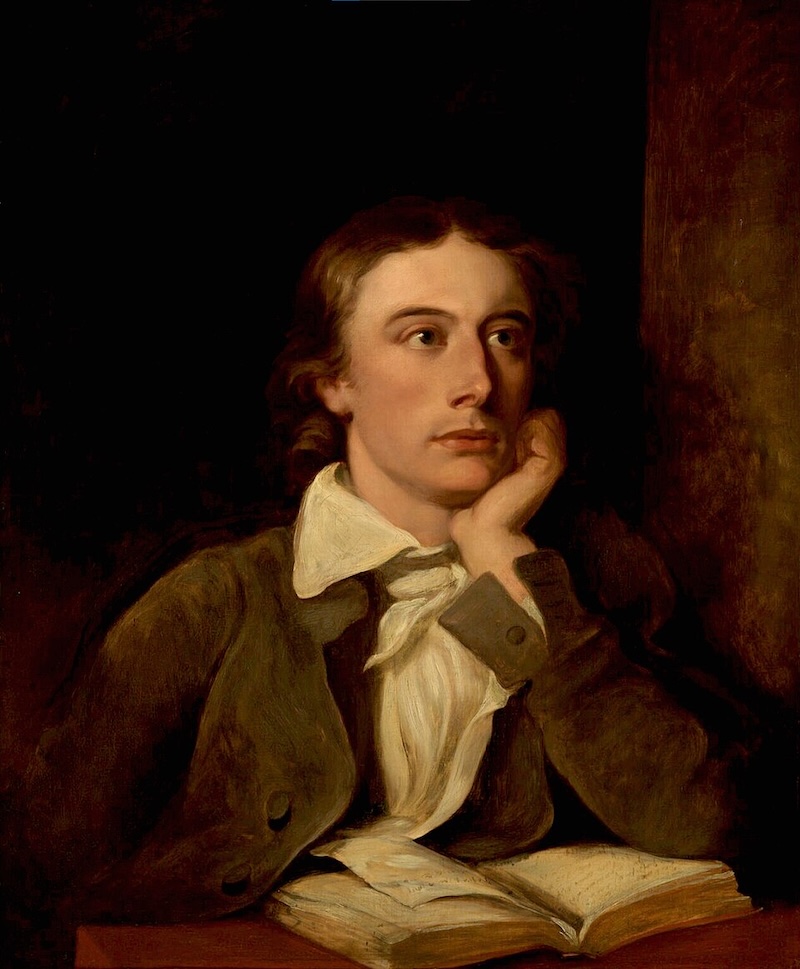
People who indulge their senses to excess are often reproved as sensualists or voluptuaries — a censure that would never attach to Keats. Yet has there ever been a more sensuous poet?
His vivid imagery and his evocation of the physical world — the fragrance of flowers, the beauty of the night sky, the gentle breathing of a young woman asleep — reveal how keenly he observed life. Celebrated as one of the great Romantic poets, he does not merely describe what is beautiful and inviting; he renders it so irresistibly that the reader is mesmerised.
Has there ever been a more sensuous poet than Keats—who could write of “beaded bubbles winking at the brim” of a glass of wine and long to be “pillow’d upon my fair love’s ripening breast… awake for ever in a sweet unrest”?
(Photo credit: John Keats by William Hilton, Public domain, via Wikimedia Commons)
The wine in Ode to a Nightingale has lingered in my imagination ever since I first encountered the poem:
O for a beaker full of the warm South,
Full of the true, the blushful Hippocrene,
With beaded bubbles winking at the brim…
And who can forget the intimacy of the bedroom scene where he longs to be
Pillow’d upon my fair love’s ripening breast,
To feel for ever its soft fall and swell,
Awake for ever in a sweet unrest…
A short life, an enduring legacy
Keats was intensely alive to the world and possessed a rare power to translate its beauty into words. He died at just twenty-five, in 1821, of tuberculosis, in Rome, where he had gone in search of a warmer climate. By then, he had published only three slim volumes of poetry, received with mixed reviews. Not celebrated like Byron in his lifetime, he found fame later, after his death. The very sensuousness that Byron dismissed as “mental masturbation” was admired by the Victorians and has continued to captivate readers ever since.
What Keats sought above all was what he called — in a letter to his brothers in 1817 — “Negative Capability, that is, when a man is capable of being in uncertainties, mysteries, doubts, without any irritable reaching after fact and reason”. It is this quality that informs the extraordinary poems of 1819: Ode to a Nightingale, Ode on a Grecian Urn, To Autumn, Ode on Melancholy, La Belle Dame sans Merci, The Eve of St Agnes — works steeped in ambiguity, tension, and unresolved feeling.
In the haunting La Belle Dame sans Merci, a knight recounts his enchantment by a mysterious woman who abandons him, leaving him pale and alone on a desolate hillside where “the sedge has withered from the lake, / And no birds sing.” The poem refuses explanation. Is the lady a supernatural predator, a symbol of destructive love, or an embodiment of imagination’s dangerous allure? The question remains open — and it is this openness that gives the poem its peculiar power.
Death and beauty
In Ode to a Nightingale, the poem begins in physical distress — a “heartache” and a numbing sensation “as though of hemlock I had drunk” — and tries to escape human suffering variously: through wine, through imagination, even through thoughts of death. In darkness, the speaker imagines himself surrounded by unseen flowers known only through their fragrance — the “musk-rose” and the “dewy wine” — while the nightingale’s song becomes a symbol of timeless beauty. Though “half in love with easeful Death”, the poet realises that death would deprive him of beauty itself. The poem ends unresolved, with the haunting question: was this “a vision, or a waking dream?”
Ode on a Grecian Urn is also a meditation on beauty and immortality. The ancient urn, adorned with scenes of lovers and musicians, seems to promise immortality: the lover will forever be about to kiss, the music forever new, the trees forever in leaf. Yet this permanence is also a form of imprisonment. The figures are “for ever panting, and for ever young”, suspended in unfulfilled longing. The urn is both beautiful and cold — a “Cold Pastoral”. The poem ends with a ringing affirmation that also acknowledges the limits of human knowledge:
Beauty is truth, truth beauty, — that is all
Ye know on earth, and all ye need to know.
Permanence and transience
In Bright Star, too, Keats reflects on permanence and transience. He admires the steadfast star for its constancy, but he does not want its ”lone splendour”, its eternal solitary vigil. Instead, he imagines himself “pillow’d upon his fair love’s ripening breast,” awake in a “sweet unrest,” feeling its “soft fall and swell” — wondering whether to live thus forever or “else swoon to death”.
The poem articulates Keats’ key concerns: constancy and change, love and mortality, solitude and intimacy. The star represents an inhuman permanence; human love, though fleeting, offers warmth and closeness.
Keats knew he was dying even as he wrote his greatest poems. His letters to Fanny Brawne — whom he loved deeply and hopelessly, and whom he depicted in Bright Star — are known for the same mixture of joy and anguish, longing and the sense of mortality, that animates the great odes.
What makes Keats enduring is not only the beauty of his lines — ravishing as they are — but the seriousness that underlies them. He celebrated beauty, yet he also insisted that poems must confront grief, longing, and mortality. In a handful of poems, written at fever pitch by a young man conscious that his time was short, he depicted beauty, grief, and longing with an eloquence that still resonates.