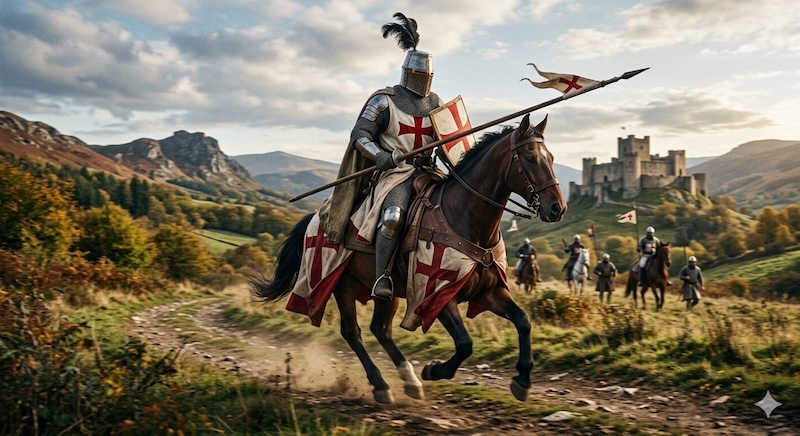
The Iran war suddenly made me think of the Crusades. I am surprised I have not yet seen any comparisons being drawn. There are, of course, obvious differences. This is not, for most of the adversaries at least, a religious war. They are not fighting for the Holy Land. The stated aims are to curb nuclear proliferation, promote regional stability, and defuse threats to oil shipping in the Gulf. The Crusaders, by contrast, wanted to recover Jerusalem from the Muslims. They believed they were fighting for a holy cause as religious warriors in different ages have done. Despite the differences in aims and motivations, the Crusades and the current war are part of the same historical pattern of engagement – and conflict — between East and West.
The Crusaders who won—and lost—Jerusalem were, in a sense, the forerunners of later Western involvement in the Middle East.
(Photo credit: AI generated/Gemini)
It is an age-old struggle waged since antiquity. History remembers the Battle of Marathon, where the Athenians defeated the Persians; Hannibal’s war with Rome, which ended in his defeat; and the conflict between Egypt and Rome, which Shakespeare dramatized so vividly in Antony and Cleopatra. The die is cast when Antony abandons the battle to follow Cleopatra as her ship flees — his humiliation witnessed by his friend, Enobarbus (Act III, Scene 10). Octavius triumphs. Antony never recovers. Both he and Cleopatra die by their own hands, and with Cleopatra’s death the Ptolemaic dynasty in Egypt comes to an end.
From Cleopatra to Suez Crisis
The West prevailed then, but the East won the long game. After Cleopatra’s death, Egypt came under Roman rule, and when the Roman empire split, it became part of the Eastern Roman or Byzantine empire. However, Arabs conquered Egypt in the seventh century, and it has been Muslim ever since. It became a British protectorate in the late 19th century, but only for a short time. British, French and Israeli forces were forced to abort an invasion of Egypt under American pressure after the Egyptian government nationalized the Suez Canal in the Suez Crisis (1956-1957).
The brief British sway over Egypt was similar to the experience of the Crusaders. The Crusaders recovered Jerusalem and created four kingdoms — Jerusalem, Antioch, Tripoli and Edessa — collectively known as Outremer, meaning “beyond the sea”. But these Crusader states did not last. Born at the close of the 11th century, they were all gone by the end of the 13th. They depended on a continuous flow of men and money from Europe, and that support eventually dried up. The religious fervour that had launched the Crusades slowly burned itself out.
The weeks’ old Iran war is by no means comparable to the Crusades fought over centuries.
The modern Western world does not share the piety of the Middle Ages, yet the struggle between East and West continues. Western influence since the 19th century has redrawn the map of the Middle East. The victors of the First World War carved up the Ottoman empire and created new countries: the British fashioned Iraq and Jordan and promised “a homeland for the Jews”; the French were given the mandate over Lebanon and Syria. Their histories have been bloody ever since. Iraq, Lebanon and Syria continue to be wracked by violence, while Israel fights what seems a forever war — one for which its enemies must share the blame. The omens were never auspicious. Britain had to suppress tribal uprisings in Iraq, France fought rebels in Syria, Jews and Muslims clashed in Palestine, and the notorious Jewish Stern Gang also fought the British. The collapse of the Ottoman empire, in short, created a hornets’ nest that has never been subdued.
Why the Crusades began four centuries after loss of Jerusalem
What is intriguing about the Crusades is why they happened when they did — four centuries after Jerusalem fell to the Muslims. The immediate trigger was a plea from the Byzantine emperor Alexios I Komnenos to Pope Urban II for help in reclaiming Anatolia from the Seljuk Turks. The pope saw his opportunity: to strengthen papal authority and unite Christendom. He began a preaching tour of his homeland, France, to recruit warriors. At the Council of Clermont in November 1095, he issued a rousing call to arms, urging Christians to liberate Jerusalem conquered 450 years earlier and promising spiritual rewards to all who fought.
The First Crusade, led by French and Italian nobles, set out in 1096. They rendezvoused with the Byzantine emperor in Constantinople, captured Antioch (now called Antakya in Turkey) in June 1098, and entered Jerusalem in triumph in July 1099 — victories that gave rise to the four Crusader states.
The story after that is one of intermittent glory and steady decline. The fall of Edessa (now called Urfa in Turkey) and the massacre of its European population in December 1144 prompted the Second Crusade. Led by Louis VII of France and Conrad III of Germany, it ended in failure after an abortive attack on Damascus in 1148. The Crusaders continued to suffer reverses for decades.
The great Muslim warrior ruler, Saladin, crushed the army of Jerusalem at the Battle of Hattin in July 1187. That sparked the Third Crusade, bringing an equally heroic Christian ruler to the fray. Richard I of England — the Lionheart — took the city of Acre (now called Akko in Israel) but could not retake Jerusalem and returned home, having secured only a treaty and pilgrim access to the holy city.
The Fourth Crusade earned notoriety with the sack of Constantinople by the Crusaders who fell out with the Byzantines in 1204
The Sixth Crusade briefly restored Jerusalem to Christian rule through a treaty between Frederick II of Germany and the Sultan of Egypt in 1229, but that, too, did not hold — the city was sacked by Muslim freebooters in 1244. Louis IX of France launched the Seventh and Eighth Crusades; the first ended with his surrender to the Egyptians in April 1251, the second with his death from plague outside Carthage in August 1270.
What the Crusaders faced
Louis was not the only king to die in the Crusades. The Holy Roman Emperor Frederick Barbarossa drowned in a river in southern Turkey on his way to the Crusades.
It is notable that kings left their kingdoms to take part in a holy war in a distant land. There were nobles who took part in the expeditions for their own gain. The crusader states needed rulers who came from their ranks. But there were others inspired by religion. They faced not only danger at war but had to travel long distances by land and sea; there were perils at sea where their ships were sometimes blown off course, like some of Richard I’s vessels, which were scattered by a storm and ended up in Cyprus. That ended in Richard’s conquest of Cyprus as he and the island’s Christian ruler fell out. There were dangers for warriors returning from the Holy Land, too. Richard I was held prisoner by the Austrians and released only after a huge ransom was paid.
Despite all the dangers confronting them, men nevertheless joined the Crusades – not only warriors but pilgrims who accompanied them to the Holy Land. They were fired by faith, intrepid with courage.
In their fight to reclaim Jerusalem nearly 450 years after it had been conquered by the Muslims, however, they were, in effect, outsiders trying to change the established order. Malcolm Lambert makes that point in his book, Crusade and Jihad.
For all their courage and faith, the Crusaders failed in their mission. They could not hold on to Jerusalem. After the second Muslim conquest of Jerusalem in 1187, it remained in Muslim control under Ottoman rule till 1917 when it was captured by the British.
“[T]here is no escaping the fact that, in the end, the Latins lost the war for the Holy Land,” writes Thomas Asbridge in The Crusades. “[In] the long run Islam did benefit from the physical propinquity of the Levantine battlefield and the inescapable fact that it was waging a war on what was tantamount to home ground.”
The Crusades are ancient history — but perhaps not utterly irrelevant. As the journalist Robert Fisk said in his book, The Great War for Civilisation: “In the Middle East, it sometimes feels as if no event in history has a finite end, a crossing point, a moment when we can say, ‘Stop – enough – this is where we will break free.” Fisk, who covered the Middle East from 1976 until his death in 2020, first for The Times and later for The Independent, knew his Middle East.