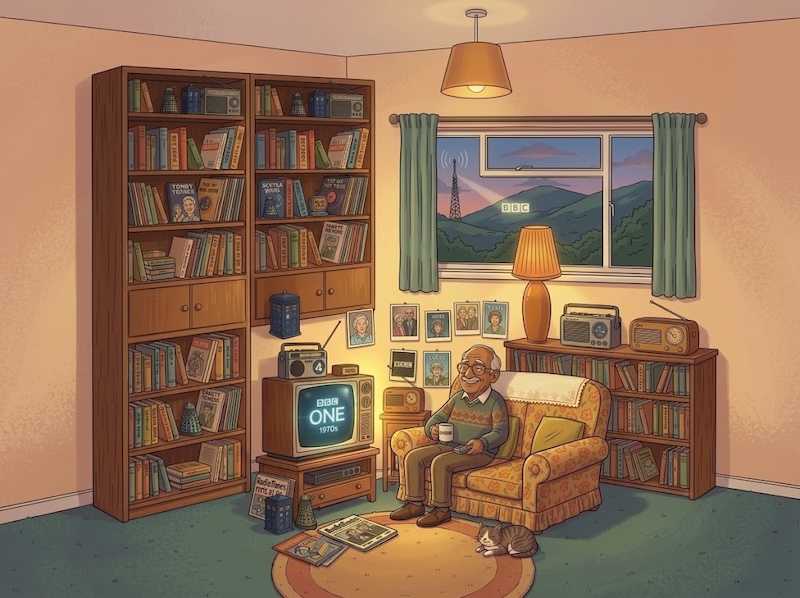
A crackling shortwave radio in Kolkata opened up a world of music, news and beautifully spoken English — and began a fascination that has lasted a lifetime.
I first tuned in for the music, and stayed for the news. That sums up my half-century-long love affair with the BBC, which began in my schooldays in Kolkata, when Indira Gandhi was prime minister of India.
I can still remember the year the love affair began: 1969, when Creedence Clearwater Revival burst onto the scene with a run of hits, including Proud Mary and Bad Moon Rising. The music was infectious, and the BBC deejays, men like Tony Blackburn and Dave Symonds, sounded wonderful. Their cheerful, exuberant chatter was as much a pleasure to listen to as the records they played.
Before long, I began listening to the news and talk programmes, too, entranced by the voices, diction and intonation of the BBC’s newsreaders, presenters and correspondents. They sounded so “posh”! Yes, I was an ordinary Kolkata boy smitten with a bad case of Anglophilia.
But it was not entirely without cause. The Indian airwaves then were virtually a monopoly of the government-owned All India Radio, which, apart from the Western music programmes broadcast by Calcutta B at lunchtime and at night, was a crashing bore. The news it aired was largely what the government wanted people to know, and believe.
The BBC World Service, with correspondents around the globe, could hardly have been more different. Even its coverage of India seemed to carry greater credibility, thanks in no small measure to its outstanding India correspondent, Mark Tully. Born in Calcutta, where his father was a British businessman, Tully had excellent contacts and knew India like the back of his hand.
Listening to the BBC, however, was not always smooth sailing. In India I could receive the World Service only on shortwave, which meant enduring bursts of static. They might have added something to the storm and thunder of a Led Zeppelin recording such as Whole Lotta Love, but they were sheer murder when you were trying to follow the news or a talk programme.
Imagine my jubilation, then, when I came to work in Singapore and discovered that I could listen to the BBC on FM: no static, no hiss, just crystal-clear reception.
Rain in the morning
But in every life a little rain must fall, and in mine, it pours in the morning. At 9am Singapore time, the BBC broadcasts Newsday from Singapore, and listening to it can be a painful reminder that my hearing is not what it was, a reminder of advancing years and declining ears.
Why can’t the BBC provide instant transcripts on screen when a speaker is difficult to understand, I am sometimes tempted to ask. The thought occurs to me particularly when Newsday is hosted by its regular presenter, Steve Lai. Tall, imposing, with an impassive face and a deep voice, he delivers the news in impeccable English that is as likely to soothe as to inform. But his voice can trail off into a murmur towards the end of a sentence. You have to be sharp to catch those final words, and I am not.
Why can’t he be more like Vandhna Bhan, the young woman who sometimes hosts Newsday in his place, I wonder. Why can’t he be more like the BBC I remember?
For if there is one quality that distinguishes most of the presenters I hear on BBC World News, it is clarity. They speak distinctly, generally at a measured pace, stressing the important words in a report or discussion so that the listener can readily grasp not merely the words but the sense of what is being said.
As a teenager listening to those crackling shortwave broadcasts in Kolkata, I knew nothing about phonetics. My acquaintance with the subject went no further than watching Professor Higgins teach Eliza Doolittle to speak like a duchess in the musical My Fair Lady. What made the BBC presenters sound so cultivated, precise and wonderfully clear was simply beyond my ken.
Received by whom?
Only much later did I learn that the accent had a name: Received Pronunciation, or RP. Received by whom, I wondered. By polite society, it turns out. “Received” meant “accepted” or “approved”, which is a fine piece of snobbery to build into a name. The linguist David Crystal explained on a BBC webpage, since archived, that the label dates from the late nineteenth century and was long associated with public schools, Oxford and Cambridge. When the BBC arrived in the 1920s, it adopted the accent for its announcers, and RP acquired a string of aliases: the Oxford accent, the BBC accent, the King’s English — and the Queen’s when the throne changed hands.
John Reith, the BBC’s formidable first director-general, was not a man to leave pronunciation to chance. He appointed an advisory committee to rule on awkward words and names, and among its members were the playwright George Bernard Shaw, creator of Professor Higgins; the phonetician Daniel Jones; and the Poet Laureate Robert Bridges.
Reith would doubtless reach for the smelling salts at today’s BBC, where modern RP shares the airwaves with Standard Southern British English and accents from everywhere. To my untrained ear, many of them still sound like the BBC English I grew up with, only less conspicuously “posh”.
Human beings are not carbon copies, and voices, like faces, differ from person to person. Geeta Guru-Murthy, a British journalist of Indian heritage, does not sound like her New Zealand-born colleague Lucy Hockings. Hockings is relaxed and conversational; Guru-Murthy more measured. Nick Robinson, on the BBC Radio 4 podcast Political Thinking, sounds sharper and more clipped than the veteran John Simpson, whose delivery is slower and more reflective. James Coomarasamy is silken-smooth. Matthew Amroliwala and Christian Fraser report the day’s news with a certain urgency; Owen Bennett-Jones has the measured assurance of a seasoned master. Their voices are individual, yet they share something more important than an accent: they speak with precision, authority and, above all, clarity.
Beyond BBC
Nor is “BBC English” confined to the BBC. The new world of podcasting has produced a host of programmes whose presenters speak with the same aplomb in clear, articulate British English.
In The Rest Is Politics, former Conservative Cabinet minister Rory Stewart talks current affairs with former Labour spin doctor Alastair Campbell. In The News Agents, former BBC journalists Emily Maitlis and Jon Sopel bring the assurance and fluency of experienced broadcasters to their political analysis.
Similarly, historians Tom Holland and Dominic Sandbrook make the past come alive in The Rest Is History. In Empire, Anita Anand’s quintessential radio voice pairs wonderfully with William Dalrymple’s patrician tones ; for good measure, the story they tell is often the story of my own part of the world.
None of this is to deny the sweep of American English, carried to every corner of the earth by Hollywood, popular music, technology and the internet.
An English that stayed
But in Kolkata, the English we learnt in the classroom and read in the newspapers was British, and the tradition persists to this day. British English continues to hold sway in much of the Commonwealth, including Singapore and Malaysia. The language did not depart with the empire. The British Council, which teaches British English around the world, says it is trusted by more than 100 million learners.
My fondness for BBC English does not end with news and current affairs. It extends to television drama, where articulate dialogue comes with picturesque British scenery thrown in — a speciality of BBC First.
I recently enjoyed watching The Marlow Murder Club, set in the idyllic Buckinghamshire town of Marlow, on the Thames. A retired archaeologist and her friends turn amateur sleuths when murders begin to disturb the town’s peace. The dialogue is unhurried, crisp and seasoned with dry wit. The Father Brown mysteries, set in the picturesque Cotswolds, exude a similar appeal.
Looking back across more than half a century, from sitting beside a crackling shortwave radio in Kolkata to listening and watching in digital clarity in Singapore, I realise that my affection for BBC English has only deepened.
Accents have changed. The BBC has changed. Technology has carried me from the temperamental shortwave dial to FM, television and streaming podcasts. My own ears, alas, now demand rather more concentration than they once did. Yet the quality that first captivated that schoolboy in Kolkata remains: the pleasure of hearing English spoken with clarity, intelligence and respect for language itself.
Perhaps that is why, after all these years, I am still listening.